VBOX 4-Based R139 Brake Assist System (BAS) Testing Application
VBOX is a globally recognized range of in-vehicle testing, positioning and data logging products developed by UK-based Racelogic. The VBOX-based R139 BAS testing application is a dedicated test solution designed for Category B Brake Assist Systems (BAS) in accordance with United Nations Economic Commission for Europe (UNECE) Regulation No. 139.
Powered by the R139 brake test plugin integrated into the free VBOX Test Suite data analysis software, this solution helps vehicle manufacturers, brake system suppliers and third-party testing organizations conduct BAS type-approval tests efficiently and consistently. Its three key capabilities—real-time validation, automatic calculation and standardized reporting—significantly improve test efficiency and data reliability.
1. Regulatory Background: ECE R139 and Category B Brake Assist Systems
1.1 Regulatory Basis
United Nations Regulation No. 139, Uniform Provisions Concerning the Approval of Passenger Cars with Regard to Brake Assist Systems (BAS), is issued by the United Nations Economic Commission for Europe (UNECE). It applies to the approval of brake assist systems installed in M1 and N1 category vehicles and serves as an important basis for market access in contracting parties.
1.2 Technical Characteristics of Category B Brake Assist Systems
Under this regulation, a Category B BAS primarily identifies emergency braking based on the rate at which the driver applies the brake pedal. When emergency braking is detected, the system provides additional braking assistance.
The regulation requires dynamic braking tests to be conducted under prescribed conditions with the BAS both activated and deactivated, in order to verify the actual effectiveness of the brake assist system.
1.3 Testing Challenges
R139 testing imposes strict requirements on triggering conditions, brake pedal application rate, vehicle speed range and the number of valid test runs. Traditional manual assessment and post-test analysis are time-consuming and prone to errors.
This is where the VBOX BAS R139 application delivers value: it transforms complex regulatory procedures into a simple, real-time and reliable engineering tool.
2. Key Features and Benefits
2.1 Real-Time Validation of Every Test Run
The R139 plugin validates each braking stop in real time, immediately determining whether the test run meets the specified regulatory parameters. Test drivers do not need to wait for post-test analysis to determine whether a run is valid, helping to avoid repeated test runs and unnecessary trips.
2.2 Automatic Calculation of Key Parameters
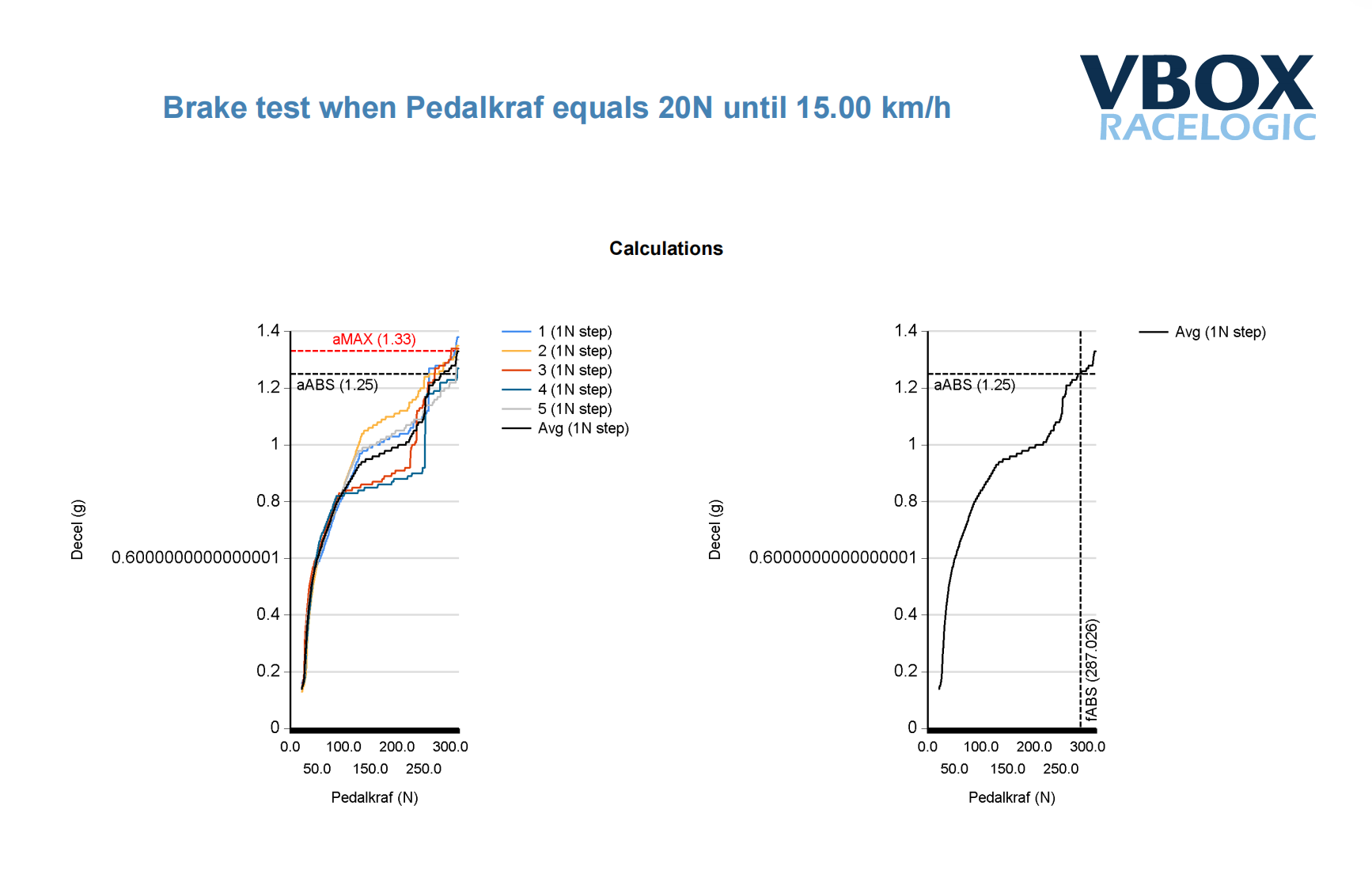
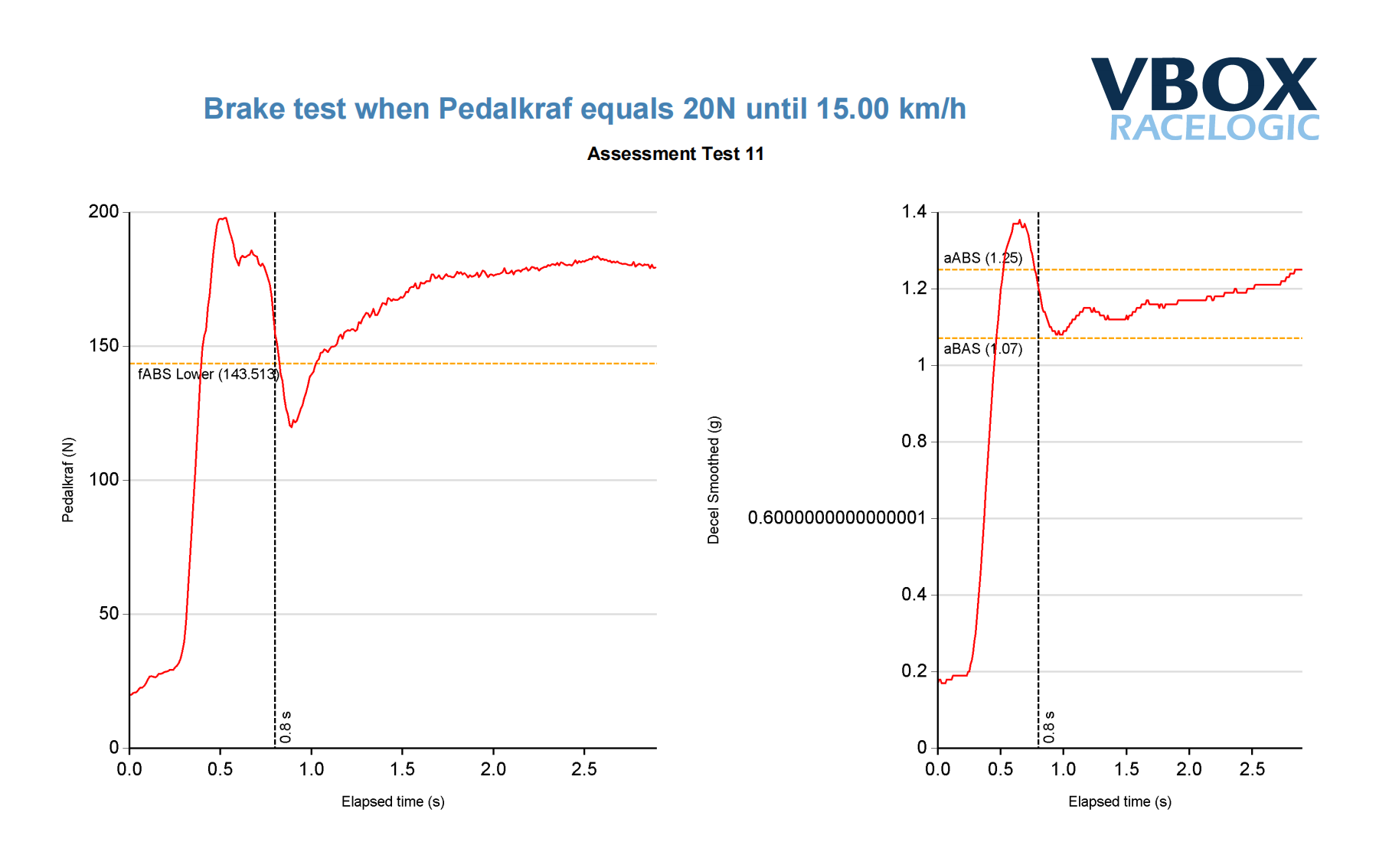
After five sets of valid reference tests have been completed, the software automatically calculates key regulatory parameters, including maximum deceleration (amax), deceleration during the ABS phase (aABS), ABS braking force (fABS) and its upper and lower limits, and deceleration during BAS activation (aBAS).
This significantly reduces the risk of errors associated with manual calculations.
2.3 Graphical Real-Time Feedback
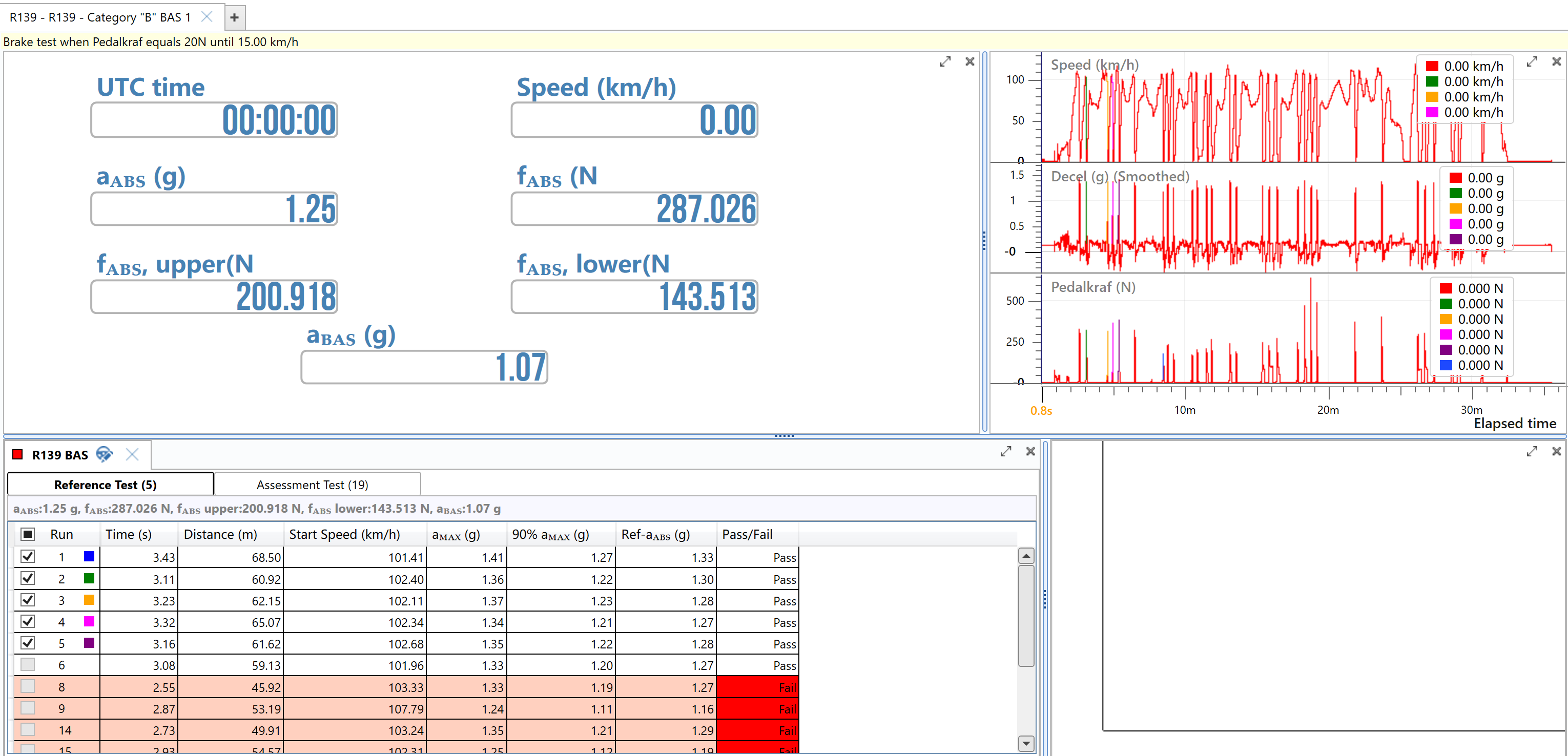
The software presents important test data graphically in real time, providing test drivers with clear and timely feedback. This allows them to adjust their driving inputs based on actual test conditions and improve the test success rate.
2.4 Flexible Parameter Configuration
The software supports brake pedal force triggering or triggering via a user-defined CAN channel. Configurable parameters include minimum trigger speed, termination speed, brake line pressure channels, brake pedal travel channels, and hand-operated or foot-operated control force channels.
This flexibility accommodates different test specifications and vehicle configurations.
2.5 Reference Test Validity Control
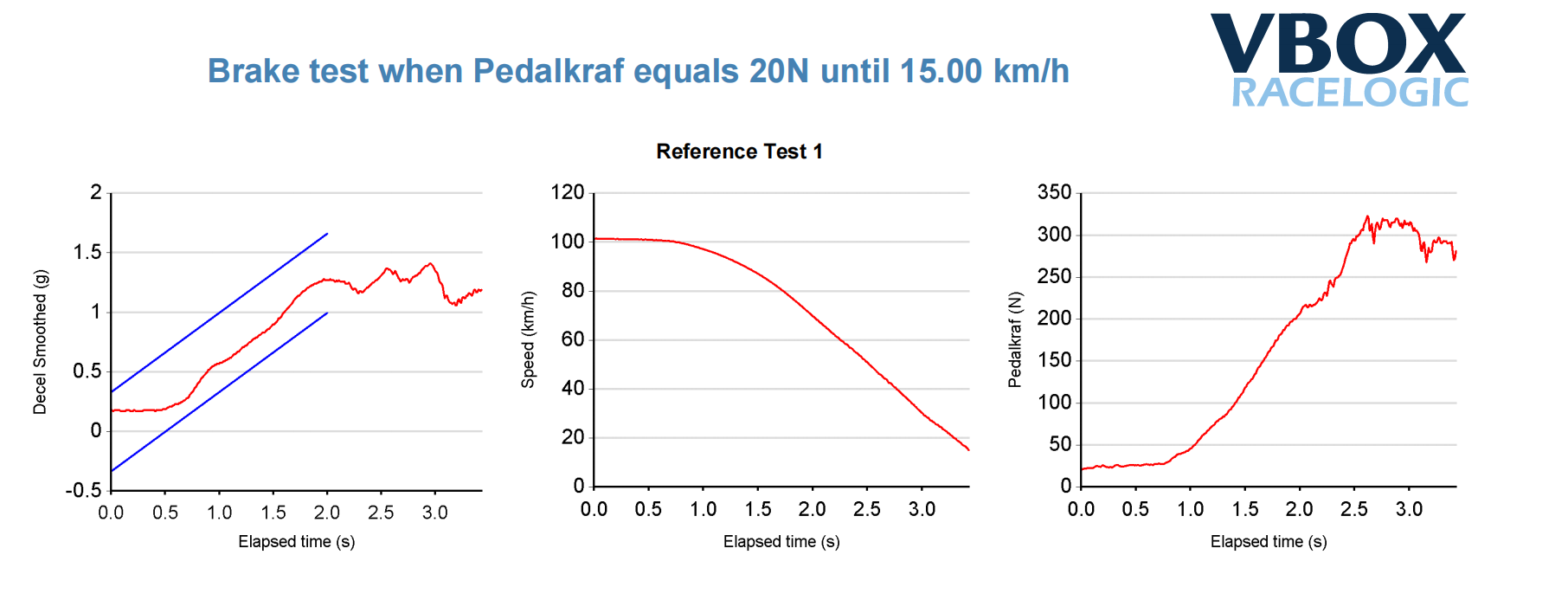
Built-in reference test validation and minimum time/distance intervals between test runs help mitigate the effects of factors such as brake fade.
Test runs that do not meet the required interval are marked in red to prevent invalid results from being inadvertently included in statistical calculations.
2.6 Standardized Report Generation
A complete test report can be generated with a single click at the end of testing. Reports can be exported in formats including Excel, Word and PDF, making it easier for engineers to share and archive results and submit documentation to certification bodies.
Images: VBOX Test Suite interface and R139 BAS testing application.
3. Technical Parameters and Test Metrics
Table 1. Main Configurable Parameters
| Parameter Category | Parameter | Description / Example |
|---|---|---|
| Trigger settings | Trigger method | Brake pedal force triggering (e.g. 20 N) or a user-defined CAN channel |
| Vehicle speed conditions | Minimum trigger speed | Configurable; example: 100 km/h |
| Vehicle speed conditions | Termination speed | Configurable; example: 15 km/h |
| Channel configuration | Brake line pressure channels | Supports two channels, e.g. master cylinder pressure / wheel cylinder pressure (bar) |
| Channel configuration | Brake pedal travel channel | Records the brake pedal travel signal |
| Braking force channels | Hand-operated / foot-operated control force | Supports braking force sensors (N) |
| Test control | Minimum time/distance between test runs | Helps mitigate the effects of brake fade |
Table 2. Key Output Metrics
| Symbol | Name | Description |
|---|---|---|
| amax | Maximum deceleration | Peak deceleration during the braking process |
| aABS | Deceleration during the ABS phase | Deceleration during ABS intervention |
| fABS | ABS braking force | Braking force during the ABS phase, including its upper and lower limits |
| aBAS | Deceleration during the BAS phase | Deceleration during activation of the brake assist system |
| MFDD | Mean Fully Developed Deceleration | Average deceleration during the fully developed braking phase |
4. Application Value and Advantages
4.1 Regulatory Compliance
Designed to address ECE R139 requirements, the solution provides a standardized and traceable testing basis for BAS approval of M1 and N1 category vehicles, supporting market access in contracting parties.
4.2 Improved Efficiency and Reduced Costs
Real-time validation and automatic calculations significantly reduce repeated test runs caused by invalid results. This shortens overall testing cycles and reduces labor and test-track costs.
4.3 User-Friendly and Accessible
The software is available free of charge to VBOX users and runs on the Windows platform. Its intuitive interface allows users to get started quickly, and it supports real-time test result viewing on mainstream tablets.
4.4 Reliable Data
VBOX systems are known for high-accuracy GNSS measurement and support for multiple sensor channels. Test data can be audited, traced and reproduced, meeting the stringent requirements of engineering validation and certification.
4.5 Standardized Reporting
Standardized reports can be generated with a single click and exported in multiple formats. This supports engineering documentation and certification requirements while reducing the workload associated with report preparation.
5. Applications
Braking systems and active safety testing departments at vehicle manufacturers (OEMs).
Research, development and validation teams at Tier 1 brake system suppliers.
Third-party automotive testing and certification organizations.
Vehicle and component manufacturers seeking export approval for markets governed by UNECE regulations.
6. Hardware and Configuration Recommendations
6.1 System Components
Table 3. System Components
| Component | Function |
|---|---|
| VBOX 4 series GNSS data logger | High-accuracy speed measurement, distance measurement and data logging |
| IMU05 inertial sensor | High-accuracy acceleration measurement |
| Brake pedal force sensor | Brake pedal force triggering and braking force measurement |
| Brake pedal displacement sensor | Brake pedal displacement and application speed measurement |
| Wheel speed / CAN channels | Wheel speed calibration and acquisition of brake pressure and brake pedal travel signals |
| Windows PC or tablet | Runs VBOX Test Suite and displays test results in real time |
6.2 Optional Equipment and System Expansion
The system supports custom CAN channel inputs for signals such as brake pressure and brake pedal travel. It can also be integrated with VBOX video overlay systems, steering wheel angle measurement equipment and other devices to form a comprehensive active safety testing platform.
Conclusion
The Racelogic VBOX R139 BAS testing application transforms international regulatory requirements into a simple, real-time and reliable engineering tool. It is a practical solution for vehicle and component manufacturers seeking to complete BAS approval testing efficiently and verify active safety performance.
7. Software Access and Technical Support
VBOX Test Suite is available free of charge to all VBOX users, and the R139 brake testing plugin can be enabled for use.
For software access, hardware purchases or inquiries about R139 testing solutions, please contact us.
End of Document